
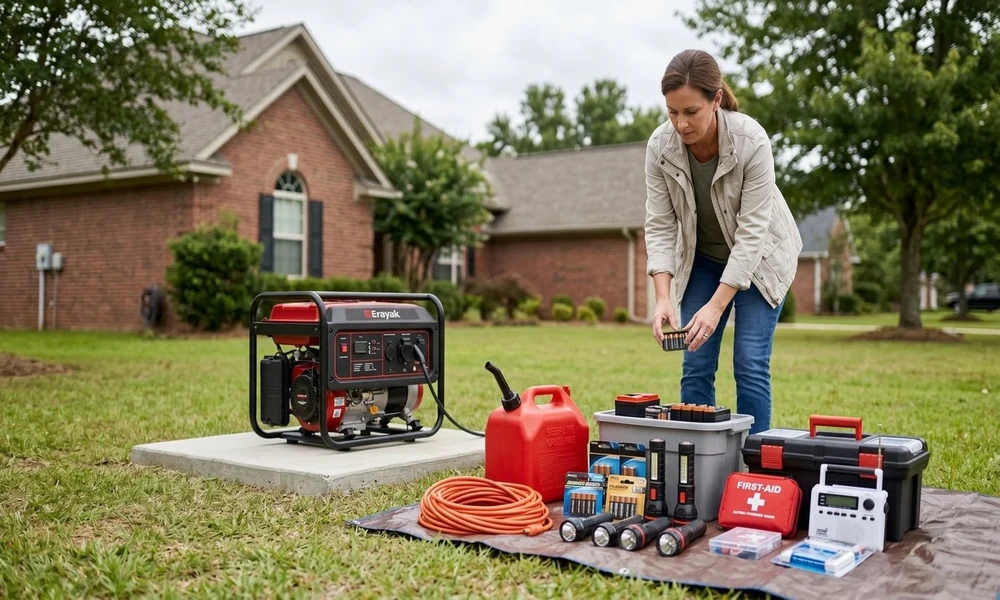
Roughly 85 Americans die every year from carbon monoxide poisoning caused by portable generators, according to a 2022 report from the U.S. Consumer Product Safety Commission. Most of those deaths happen during or right after severe weather, when people are running generators indoors or too close to their homes. Storm season is exactly when generators get the heaviest use, and it’s exactly when the risks pile up fastest. If your plan is to plug in and power through a hurricane or nor’easter without a second thought, you’re missing some things that could get you or your family hurt.
This guide covers everything you need to run your portable generator through bad weather: placement, wet-weather protection, CO risks, fuel handling, and the maintenance habits that keep a unit reliable when the grid goes down.
Why Storms Make Generator Hazards Worse
Generators produce two broad categories of danger: electrical and chemical. In dry, calm conditions both are manageable with basic precautions. Storms push both hazards into the red zone at the same time.
On the electrical side, water and electricity are a genuinely lethal combination. Using electrical tools or equipment in wet areas is a recognized hazard because when your skin is wet from rain, sweat, or standing water, its electrical resistance drops dramatically. That drop means far more current can pass through your body during an accidental contact with an energized surface. A generator running in an open rainstorm without any shielding puts every outlet, every plug, and every extension cord in play as a potential shock point.
On the chemical side, the urgency doesn’t ease once you get your unit under a roof. Portable generators create a risk of CO poisoning that can kill in minutes, and CO is called the invisible killer because it is colorless and odorless. People run generators in garages or on covered porches thinking they’re being safe, and they’re not. Walls trap exhaust even when a door is open.
The 20-Foot Perimeter Rule
Every safety authority that has studied this problem gives you the same foundational number: 20 feet. That’s the minimum distance between your running generator and any door, window, vent, or opening in your home. I’d treat 20 feet as a floor, not a target. If your yard lets you push the unit to 30 feet, do it.
The CPSC recommends placing portable generators outside only, at least 20 feet from the home with the exhaust pointed away from any nearby building. That second part, the exhaust direction, gets overlooked. The geometry of where fumes drift matters as much as the distance itself. Point the exhaust away from your house and away from any neighbor’s structure too.
The OSHA fact sheet on portable generator safety reinforces that point and goes further: keep the exhaust away from crawlspace vents and window AC units, which can pull fumes directly into a living space even when the generator is sitting outside. You can find that full guidance at the OSHA portable generator safety fact sheet.
One thing most people skip: place the unit on a flat, stable surface. Generators tipped on an angle can develop oil distribution problems and overheat. In a storm, that surface also needs to stay above any pooling water.
Running in the Rain: What Actually Works
Here’s where a lot of homeowners get into trouble. They know they can’t run the generator inside, so they set it outside, it starts raining hard, and they either shut down when they need power most or leave the unit completely exposed.
The real answer is a purpose-built generator running cover. These are weather-rated canopies, often made from marine-grade vinyl with flame-resistant ratings under NFPA 701, that attach directly to the generator frame and shed rain while leaving the engine with enough open airflow to ventilate properly. They’re not the same as a storage cover, which you’d never use on a running machine.
A DIY tarp rigged over a running generator is genuinely dangerous. Tarps restrict airflow, can catch on hot components, and often trap exhaust underneath. If you’re going to shelter your unit during operation, buy a product engineered for the purpose.
If you want a professional take on whether can a generator run in the rain, it depends entirely on how that generator is protected. An unshielded unit in a downpour is a hazard. A properly covered unit, positioned outdoors with full ventilation clearance, is a different situation entirely.
Extension Cord Basics Nobody Tells You
The generator isn’t the only failure point. Your extension cords are just as exposed.
Use only outdoor-rated cords with the right gauge for your load. A 12-gauge cord handles up to about 20 amps over a reasonable run length, while a 14-gauge cord starts losing voltage quickly past 25 feet. Using an undersized cord in a storm, when you’re running a sump pump and a refrigerator and a few lights, can overheat the cord and start a fire inside your wall or under your flooring.
Keep all cord connections off the ground when rain is falling. Plug them into a power strip rated for outdoor use and keep that strip elevated on a dry surface. Any connection point sitting in a puddle is a shock risk, even when the generator itself is properly covered.
A Practical Pre-Storm Checklist
Run through this before the next weather event, not during it:
- Test the generator under load at least once a month. Cold starts during emergencies fail more often than people expect.
- Check oil level and top off if needed. Many generators won’t start when oil is low, which is a feature, not a malfunction.
- Confirm you have at least a full tank of stabilized fuel. Ethanol-blend gasoline degrades fast, especially in heat. Use a fuel stabilizer if your unit sits for more than 30 days.
- Inspect the running cover for tears, compromised mounting points, or blocked vents.
- Verify your CO detector batteries are fresh. Place detectors on every sleeping level of your home.
- Measure the distance from your planned generator spot to the nearest opening. If it’s under 20 feet, find a new spot before storm season arrives.
The GFCI Question: Do You Need One?
Many newer portable generators include GFCI-protected outlets built in. If yours does, use them. If it doesn’t, you have two realistic paths: buy a portable GFCI adapter for any outlets you’re using in wet conditions, or route power through an indoor power strip where all the connections stay dry.
Cord-and plug-connected equipment in wet locations can get wet and expose users to severe ground-fault hazards, and OSHA agrees that using such equipment in these conditions exposes people to a risk of electrocution great enough to warrant ground-fault circuit interrupter protection. That guidance was written for worksites, but the physics apply in your backyard just the same.
My strong preference is the GFCI adapter route. It’s a $15 fix that covers you when you’re rushing around in the rain connecting equipment, which is exactly when mistakes happen.
After the Storm: Don’t Stop Here
Once power is restored, your job with the generator isn’t done. Run it dry or treat the remaining fuel with stabilizer. Wipe down any moisture that collected on the exterior. Let the engine cool fully before covering it for storage, and store it in a dry location away from living areas. Gasoline vapors accumulate in enclosed spaces, and a hot engine near stored fuel is a fire waiting for the right moment.
Schedule a service check if the unit ran hard for more than 24 hours. Filters clog, spark plugs foul, and oil breaks down under sustained load. A generator that starts beautifully one storm season can fail at the worst possible moment the next if you skip that follow-up service.
Storm season doesn’t ask permission before it arrives. Your generator plan should be ready before the first band of rain shows up on the radar, not scrambled together in the hour before landfall.